≡ Menu

Reception as a form of knowing

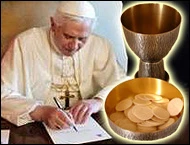
Pertinacious Papist continues his examination of life pre- and post-Vatican II with a very interesting and accurate look at the reality of the missing reverence of modern days. I can’t yet share in his quoted Mosebach’s personal distaste for receiving in the hand, but I do recognize much of what he says as thoughts that have run through my head as well. It was how I was brought into the Church and frankly has been the subject of much consternation and internal debate for me. There is something less-than-reverent that I see with many people who receive in the hand but there are also those who receive well this way which keep me from making a blanket statement.

Every time I think I’ve had it watching person after person turning away from the host before it is even placed in their hand or snatching it from the hand of the priest, deacon or EMHC along will come someone who receives Jesus in their hand as if being handed a newborn baby and coddles it with all the care they can muster. Certainly as well there are those who receive on the tongue without even a modicum of reverence, although my personal experience is rather limited since the great majority I see these days receive in the hand. But the good doctor correctly reminds us that liturgical deformation is not purely about hand-vs-tongue reception:

The new outlook sees all the fastidious formulas, prescriptions and proscriptions of the old Mass as representing a flight away from actuality. It wants to simplify things, demystify things, demythologize things and get to the essence of things. However, in doing so, it misses the counter-intuitive insight that the shoe is actually on the other foot: all of these external forms, in fact, facilitate our advance towards actuality and usher us into the precincts of the Real Presence of the Person of Christ Himself.

Indeed, the question is not about what acts are done nor about in which exact way they are done. If one follows, to steal from St. Paul, all the prescriptions and proscriptions of the Ancient Mass but does so without love, the altar bells may as well be a clanging cymbal. We all, collectively, must come to a deeper and more personal understanding of just what it is that’s going on “up there”. Then the question of reception, of genuflection, of physical orientation will be discussed in a manner worthy of Him whom they consider. When we all come to realize the intent of those prescriptions and proscriptions, to see their liberating rather than oppressing purpose, then we will see that reform of the reform.

The great beauty of the Ancient Mass is that it is “prayed” rather than “participated”, “celebrated” rather than “presided”. At the same time, those properties need not be the exclusive purview of that Mass but rather must become central to the liturgical celebration of Mass throughout the Church, regardless of rite or country, priest or congregation. I pray that day comes soon.

Personal aside: I think I’m in the same position as Rich Leonardi only a short time ago – knowing what probably needs to be done, but in the awkward position of knowing (or, at least, thinking) some will sneer in condescension at my supposed act of superiority. And the last time I walked up to receive on the tongue, the host was almost placed in my breast pocket by a priest who hadn’t even looked up from the ciborium. After that embarassment to both the priest and myself I lost a bit of the nerve to be one of the handful in my parish who receive on the tongue. So in the interim, I carefully and lightly moisten my finger tips which held the host and carefully wipe my palm into which it was placed, waiting for the day when my courage to counter that culture returns.
{ 0 comments }

Debunking the spiritual acid trip

Dr. Phil Blosser has posted an excellent reflection on the state of the liturgy vis-a-vis the desires of the Second Vatican Council especially as stated in Sacrosanctum Concilium. Of course, if you know the good Doctor, it doesn’t stop just there. In particular I find his question on whether the ready accessibility of every part of the Mass to the people without some amount of intellectual exercise is in fact damaging to their overall comprehension to be both accurate and timely.

But the issue goes a bit deeper than these extraneous (if entertaining) horror stories. The question, really, is what does it mean that anyone should want to make the Mass “more real”? We already know by virtue of the principle of ex opere operato that the miracle of Transubstantiation objectively occurs and the sacrifice is rendered present for us on the Altar, regardless of what anyone perceives or feels. What more could we want? If the sixties, which gave birth to these strategies for “making it real” are any indication, I suppose what we want is some intensification of feeling generated by external means: the spiritual acid trip. We do not want to rely upon our own disciplined active effort in entering into the cosmic rite unfolding before us so much as to be passively swept up in the event, the ‘happening’, the warmth of the engaging priest’s voice and words, his stories and jokes, the personal experience of the communal shared moment. In short, whether or not we thought there really was anything to this medieval mumbo jumbo about Transubstantiation, what we finally want is the piano bar, Jay Leno, and the acid trip.

Although this does bring to mind a question. If before what was going on “up there” wasn’t spoken of, and what is going on “up there” is still not spoken of at the pulpit, then why do we think people are going to understand what is actually going on up there? Have we settled, or rather have some in the Church settled, for a “good enough” understanding of the Mass? As I suggested in his combox, “the most closed mind is the one that thinks it already has the answer and needs know no more”. Put another way, that which seems obvious invites no deeper reflection to those not already inclined to dirty their hands in the hard work that is understanding the infinite. What do you think?

{ 0 comments }

Who says they’re not after us?

There are so many clichés I can throw out here. “Leave it to the French to surrender before the war starts.” “You’re only being paranoid if it isn’t true.” On and on. (And yes, if you take offense to the first one realize just how French the neighborhood I live in is and you’ll understand that it’s purely tongue-in-cheek. C’mon, lighten up.) If it weren’t so comical it would be downright threatening. From CWN:

Paris, Mar. 8, 2007 (CWNews.com) – The Green Party candidate in the French presidential race has declared flatly that religion has no place in public life.

“In today’s France, religious can only exist as a private matter,” Dominique Voynet said an interview with La Croix newspaper. He said that he could see rare exceptions to that rule, such as the inclusion of religious representatives on the National Ethics Committee.

The Green Party candidate opposes public funding for the construction of mosques. Instead he proposes that unused Catholic churches “which are after all the property of the entire nation and must not only serve Catholics” be given to other religious confessions.

No, wait. I’m not laughing either. Tell me how someone who thinks Catholic Churches should not be reserved for Catholic worship (and replace the word “Catholic” with any other denomination or indeed replace “Catholic Church” with “mosque” and invert the sentence) can rightfully be called a serious candidate. It was not long ago someone who publicly said such a thing would be rightfully and clearly identified as a bigot and sent along on his way. Now, instead, the person is a candidate for the presidency of a country who is a permanent member of the United Nations Security Council.

{ 0 comments }

Schall on the two cities

Over at Ignatius Insight Fr. James Schall, S.J. has a very interesting post on his reading of the concept of the “two cities” as most famously written about by St. Augustine in his City of God. The post takes several turns and touches on several different topics, but if you have read Schall before that’s neither surprising nor a derogatory statement. Two parts in particular jumped up and grabbed me. First, he does a nice job dealing with the question of how voluntary our salvation is. I’m not arguing for or against it, but bringing it up as a well-handled short reflection on the issue.

That there be these “two cities” was, however, part of the original consequences of the basic terms of a creation. Within creation was to be found a free creature endowed with reason but one who was finite, who is not God. Indeed, since these rational beings called men are not gods, there were evidently to be, down the ages, billions of them. Their “collective” meaning in history became itself a problem, especially if the collective meaning is seen as opposed to the divine purpose. At all times in history, no doubt, some thinkers maintain that, in fact, at the end of time, only a “city of God” will exist. No “city of man” will remain. In this optimistic view–if it is indeed optimistic–everyone will somehow be saved or redeemed by God’s power or mercy no matter what they do or hold.

Such an apparently consoling view, when spelled out, implies a rather uninteresting and un-dramatic world in which little seems to be at stake. Nothing can be lost, so why worry? We will eventually be “saved” no matter what we do or think. We are not really very important. God knew all along that He would save us. We were given empty threats. Our worldly existence is a kind of game. If we lived in a world in which, to cite Tolkien’s dictum, absolutely all of our deeds were “in vain” (a notion already found in Aristotle), little sense remains in existing at all. If, on the other hand, it is our deeds that exclusively, by our own powers, save us, then we are already gods. In this latter case, we must be content exclusively with what we can give ourselves. Not a few would call this latter condition “hell” itself.

So what he is saying, in short, is that the concept of an “empty Hell” which some theologians have speculated on holds no great promise to him. Indeed, if your only eschatological choices are between a heaven desired from early in life and the same heaven chosen for you at or after the end of your life, where does that put the very revered concept of free will which is at or near the core of our understanding of our being made in the image and likeness of God? He then continues:

More than one writer has noted that, in recent centuries, men have assimilated to themselves attributes that formerly were considered to be exclusively of the “city of God.” In this world, we not only have a “right” to pursue “happiness,” however defined, usually by us, but, more astonishingly, a right actually to be happy, as if it is something we can give ourselves.

Whole classes of people no longer appear on our streets because they have been selectively aborted. They are often eliminated on the grounds that they could not be “happy” either with their actual parents or with their less than perfect physical corpus. They do not make this decision to not exist for themselves. We make it for them.

We hear discussions of the “right” to a “perfect child,” because otherwise we would unjustly bring into the world a less than perfect child who might look like our uncle or grandmother. We are working to sue those, even our parents, who let us be born deformed. Perfection has become the enemy of the normal. The normal no longer have control of the definition of who and what they are.

First, as an aside, I must make a statement of marvel at his ability to transparently move from the topic of eschatology to abortion – that, to me, is quite impressive. But even at that I think the last sentence quoted has more depth than allowed here. “The normal no longer have control of the definition of who and what they are” can mean more than just those who could lead normal even if in some way hampered lives and extends to our ability to define anything as either “normal” or “acceptable”. When everything is “acceptable” the word and its counterpart lose their power. What a very dangerous world we live in when we forget to seek the City of God.

Do read the rest of the post – there is much there that I haven’t touched on here. You’re shocked I said that, aren’t you?

{ 0 comments }

You can’t not pray for her

Rorate Cæli has a prayer request for a little girl named Anita. Hit the link, look at the innocence in her eyes and tell me you can resist saying a prayer for her. Go ahead – I dare you. “She is 15 months old, and four tumors have been found at the base of her brain, one of which may severely affect the medulla oblongata.Ave Maria, gratia plena!

{ 0 comments }

From CNA:

.- After over a year of work, the Holy See will release the post-Synodal Apostolic Exhortation on the Eucharist, titled “Sacramentum Caritatis,” on Tuesday, March 13th. The document, which flows from the 11th Ordinary General Assembly of the Synod of Bishops, held in October of 2005, has been highly anticipated in ecclesiastical circles.

A press conference for the document’s release will be held in the Press Office of the Holy See, led by Cardinal Angelo Scola, patriarch of Venice and relator general of the 11th Ordinary General Assembly of the Synod of Bishops, and Archbishop Nikola Eterovic, secretary general of the Synod of Bishops.

The document is rumored to be a profound reflection on the Sacrament of the Eucharist and may call for a proposal and plan for liturgical reforms, including a greater use of the Latin language, Gregorian chant, classical polyphonic music. According to one source, the document may also call for “more decorum and liturgical sobriety in the celebration of the Eucharist, excluding dance and, as much as possible, applause.”

CWN adds:

Some Vatican sources have suggested that the unveiling of the apostolic exhortation could clear the way for another long-awaited papal document: a motu proprio allowing wider use of the pre-conciliar liturgy. In announcing the release of Sacramentum Caritatis, the Vatican press office made no mention of that other document.

It’s going to be a very long seven days. I can’t wait to see what it has in store for us. “[M]ore decorum and liturgical sobriety” … there are some who are certainly apoplectic right now. May the reform of the reform have taken its first giant step forward. I like the name – Sacramentum Caritatis has a nice ring to it.

{ 0 comments }

India gets it…

From CWN:

Mumbai, Mar. 6, 2007 (CWNews.com) – In an unprecedented order, the highest consumer court of Mumbai in western India has ruled that “unborn child is a living person”, reports the Times of India on March 6.

Rejecting an insurance company’s decision to reject claims for compensation in a road accident in which 7-month pregnant woman died along with her husband in a car accident, the Maharashtra state consumer court ruled that the victims’ family was entitled to compensation for the unborn child, too.

The term “human fetus” implies that the organism is alive and growing. Hence, an unborn child in the womb is living and entitled to personhood, declared the consumer court, ordering the insurance company to pay the accident insurance for the “unborn.”

If India gets it, why can’t most of the rest of the world? One does wonder how long before Planned Parenthood sends “advisors” to India to try to undo this decision which is most damaging for their cause. I did an absolute double-take when I read this.

Tags: , , ,

{ 0 comments }

Argentina a "situation of urgency"

From CNA:

.- Bishop Adolfo Urinoa warned last week of the faith of the people faces a “situation of urgency” and that Catholics need “to be disciples today, here and now.”

The bishop exhorted the faithful to be authentic disciples of Christ in order defend the religion of the people, which is facing “a decisive crisis” due to tremendous cultural changes and the media, which “fosters mistrust for the Church and for the values she proposes.”

“As disciples we learn to live as Him (Christ), in order to allow Him to shine forth in the way that we live, in our attitudes and actions, and thus make Him present to others and to facilitate the encounter with the living Jesus, particularly those who are far from Him and do not know Him,” Bishop Urinoa said.

He also expressed the need to exercise discipleship in community, in order to thus “transmit a testimony of fraternity that arises in those who know each other and feel unconditionally loved by God.” This “sacrament of communion with God and between each other is normally the necessary condition for the formation of a disciple,” he continued.

“Maturity in following Jesus requires living ecclesial communities that strive each day to live unity on the basis of the Word and the Eucharist,” he explained.

Bishop Uriona also encouraged discipleship through the commitment to the poor and those left out, because they are a sort of “present-day sacrament” of the “presence of God who has given himself up for us.” Mary, he added, should be the disciple’s model of loving and attentive listening to God.

Concluding his comments, the bishop called on the faithful to take advantage of Lent to be converted and to strengthen “our relationship with Sacred Scripture,” which “nourishes our existence as disciples of Jesus Christ” and helps us to bring the Gospel “to this tired world that is full of the signs of death.”

That’s a very saddening reflection on the state of affairs in a continent once considered the great hope for the Catholic Church. It is sad, but not surprising, to see what a damaging effect even the slightest embrace of secularism can have. One must be concerned during times like this when the Church is attacked and there are nutcases like Chavez loitering around the area trying to both cause trouble and look like the salvation from that same trouble. These are interesting times, indeed…

{ 0 comments }

On attacking bishops

After reading this post from Uncle Di, where he praises the selection of Bishop Nycz as the new Archbishop of Warsaw, I read the following in the combox from commenter “opraem”:

our bishops believe they did nothing wrong in the handling of the abuse crisis. their failure has led to a piece work solution driven by the media, courts and legislatures. drip, drip, drip over a period of years. the credibility of the us hierarchy is gone and their public voice has been mute, as a result. they failed to make problem management theirs, and are subject to the rule of others. what about embezzlement and theft? will they learn from their mistakes? deja vu all over again.

I’ve heard the same sentiment on many other blogs and comboxes. Now maybe it’s just me being a convert and not having been oppressed by the Church hierarchy my whole life, but I just don’t get what positive good lumping all of the Bishops in the US together can possibly achieve. I understand the need to vent frustration at the seeming inability of some Bishops to take the abuse (both sexual and financial) bull by the horns and “fix” the problem – and isn’t that a peculiarly American thing to do, to assume that with sufficient effort any problem can be solved purely by the sweat of the brow of a responsible person – but to tar and feather those who are either quiet or conscientiously slow together with those who are inept or even possibly corrupt can never be anything but counter-productive.

Our role as laity is to help our Bishop do his job and by extension help the rest of the Church do Her job in this world. The Bishop’s job in turn is to shepherd his flock using all three aspects of his crozier (the point to poke laggards, the crook to corral wayward sheep and the stiff spine to stand erect both in rule and as example) and when necessary to figuratively use that crozier in its very original sense – to fight off the wolves who would devour the sheep who strayed too far away. But that third part, to stand erect, is very hard to do when those who should be supporting you are whacking away at your knees and shins.

At this point, I’m sure certain people probably have their blood boiling thinking that I’m suggesting a blind obedience to our Bishops. Take a sip of your drink and relax, I do no such thing. There absolutely are Bishops who are deserving of scorn and ridicule, and more likely than not the entire organization of the USCCB must be re-thought from the ground up to allow Bishops to be more collegial and less led by the “in-crowd”, but those issues cannot be our day-to-day focus. When a Bishop does something patently ridiculous (some would argue, for example, Cardinal Mahoney’s Rainbow Fish program at one end or Archbishop Wuerl’s refusal to publicly admonish politicians publicly unrepentant of mortal sins at another, would qualify) they must be called to task. But we have been given the path to follow in this case, and it doesn’t start with press releases:

If your brother sins [against you], go and tell him his fault between you and him alone. If he listens to you, you have won over your brother. If he does not listen, take one or two others along with you, so that ‘every fact may be established on the testimony of two or three witnesses.’ If he refuses to listen to them, tell the church. If he refuses to listen even to the church, then treat him as you would a Gentile or a tax collector. (Mt. 15-17)

The distinctive marks to this approach are patience and straightforwardness. I honestly can say I don’t know where we are with Bishops like Cardinal Mahoney who has flouted instructions (e.g. Redemptionis Sacramentum) or those who demonstrably failed in their duty as shepherds to protect their flock and have not altered their approach. But I must also admit a certain personal dissatisfaction with the somewhat corporate approach my own Bishop, John McCormack, has received from various corners because of his past actions as Chief of Staff to Cardinal Law. I find his decision to hand over some of his authority to the State of NH as a condition to settle the lawsuits against the Diocese curious and possibly even dangerous, possibly due to his weak standing due to his past in the Archdiocese of Boston. He has, however, done some good things since then.

What I find disheartening, however, is his relative silence from a pastoral perspective. Perhaps, after reading regular articles from Bishops such as Vasa, Bruskewitz, and Chaput I am asking too much from him. But I’ve also felt a palpable distrust and sometimes distaste for him from some in the Diocese and that simply isn’t right. As Bishop of this Diocese the above is probably the most questionable decision he has made (okay, we still don’t have a TLM in this Diocese, but that’s altogether a different question) and it is positively un-Christian for him to still be paying for any mistakes he may have made in his previous position. If anything, he has been over-protective in this regard since his assignment here. It is almost as if there are people clamoring for leadership but then saying “but not from him!” and that’s not right. If anything, we should be offering him support that, for at least as long as he is our Bishop, he may be emboldened to stand in the breach, to stare down the wolves and to serve as that uniting episcopal bond between this small part of the Church and the Church Universal.

So, did I say anything that makes any sense? Do tell…

{ 0 comments }

Update(?) on the Motu Proprio

Rorate Caeli gives us the latest from Le Figaro. According to their translation, the motu proprio is on the Pope’s desk awaiting his signature. Of course, we’ve suspected that to be the case for some time now. The more interesting part I found was this (accent mine):

The Roman Curia is divided. … Benedict XVI thus takes his time to prepare the publication and reception of the text. He could have therefore changed the juridical nature of the decree.

Now…maybe I’m just reading a little to closely between the lines, but this does suggest the possibility that the Pope is taking his time to “soften” the opposition to the motu proprio such that the previously understood limitation as only for “private masses” may be removed. In the end, that is where this must go if it is to be successful. In order for the TLM to have the desired effect on the celebrations of Pauline Mass it must not be restricted to the corner but allowed to breathe freely that its proper dignity might be restored.

As I’ve said before, both the Pauline and Pian rites have their place in the proper diversity of a Church that is catholic as well as Catholic. There is certainly much house cleaning to be done in the way an unfortunate portion of the Church celebrates the Pauline rite and I believe allowing the Pian rite to breathe freely is one of the tools we will need sweep the dirt out from under the rugs. All in time. In the mean time, pray for the Pope, for those who support him and those who oppose him. And pray for those priests who have lost the sense of reverence in their celebration of any Mass anywhere. As Fr. Z would say, “save the liturgy, save the world”.

Update: The Catholic blogosphere is a fast place. As soon as I hit “publish” on this one I saw this post from Fr. Z where we find the following (the reference is to this article in Envoy Magazine):

According to Mershon’s account of what Msgr. Schmitz communicated in the talk, the M.P. will allow every priest of the Latin Rite to say the older, “Tridentine” Mass not only privately (which he says priests can do now even without special permission) but also publicly. Many have wondered just how that would work, since seemingly it doesn’t allow much room for the rights of local bishops.

According to Mershon’s piece, if a bishop wants to block a priest from using the older Mass he would have to write to and get approval from the Pontifical Commission “Ecclesia Dei“. On the other hand, priests would have recourse to the Commission in case of trouble. It remains to be seen if that is really the solution to the dilemma, but, while still problematic, it is not bad.

{ 0 comments }