by frival
on March 23, 2007
So gossip is one of those nasty sins, but I’m only doing it to pass along the information I’ve seen thus far. Both NLM and Zadok have noticed the following in the Bolletino (the Vatican News Bulletin, but writing it in Italian sounds so much better) today:
Il Papa ha ricevuto ieri sera in Udienza:
Em.mo Card. Francis Arinze, Prefetto della Congregazione per il Culto Divino e la Disciplina dei Sacramenti;
Em.mo Card. Darío Castrillón Hoyos, Presidente della Pontificia Commissione “Ecclesia Dei”.
This translates (thanks to Zadok) as:
Yesterday evening, the Pope received in audience:
Francis Cardinal Arinze, Prefect for the Congregation for Divine Worship and the Sacraments
Darío Cardinal Castrillón Hoyos, President of the Pontifical Commission “Ecclesia Dei.”
Given the positions of Cardinals Arinze and Hoyos, this is of course setting off speculation that this audience was directly related to the not-so-patiently awaited Motu Proprio. Not that it takes much of anything to set off rumors, but this one has three dots that certainly form a straight line. We shall see what comes of it. March 25 is only two days away, you know, and its actual celebration a day after.
{ }
by frival
on March 23, 2007
It just gets harder as time goes on. It used to be, if you set your way-back machine, that it was almost uniformly considered a good thing to help out those less fortunate than yourself. Now we have constant pressures, constant worries that the person may be out to fleece you, or they may actually be planning to attack you, or they’ll only buy booze or what have you. Now be honest, have you ever driven by someone on the side of the road who looked like they needed help but had a sudden “what if they’re going to…” thought cross your mind and convince you to drive on? If you haven’t, contact the Vatican’s Congregation for the Causes of Saints.
For the rest of us, this article may just be a painful reminder of some of those times where our fear overtook our conscience. We all know we are called to help our fellow man – I think any Christian can quote almost by heart “For I was hungry and you gave me food, I was thirsty and you gave me drink, a stranger and you welcomed me, naked and you clothed me, ill and you cared for me, in prison and you visited me.(Mt 25:35-36)” But we also have ringing in our ears the news stories of people carjacked, people attacked by those posing as in need of help, of people being killed trying to do what is right. Then we look in the faces of our children and say “somehow you must come first”. And then we undertake that mental balancing act of “do I protect the image of God in the children He entrusted to me, or do I help that image of Christ in the person who appears to need my help?” So what do you do?
I know I’ve all too often given in to the fear that the person may intend harm. But Christ also reminds us to “be not afraid”. It is indeed a fine balancing act we have been called to, and a reminder that a life of prayer opens us to hearing God’s will for us in even these things. And yes, at times, to listen to our Guardian Angel tell us when to move along.
H/T to Father Jonathan. Yes, that Father Jonathan. Forgiveness is a Christian trait as well.
{ }
by frival
on March 23, 2007
Not that such a thing is new, by any stretch. LifeSite gives us the scoop. In a story in the Ottawa Citizen, Hans Kung took the opportunity to unload on his old friend, our Pope. For starters:
Kung told the Citizen that the Pope’s stance supporting the moral law and the traditions of the Catholic faith is a result of fear. Painting his former academic colleague as a paranoid autocrat, Kung said, “He got more and more conservative, more and more frightened.”
Now do a compare-and-contrast with this post I wrote on why he is taking so long with the Motu Proprio and see which one seems more like the Benedict we’ve come to know. Kung approaches Benedict with a negative psychology which assumes everything he does stems from a fear of loss – one could almost say it’s a secular ideology which concerns itself with worldly things. I’d suggest instead approaching it from a positive theology point of view where his concerns are founded on the desire to ensure those entrusted to his care do not teeter off into the weeds but stay on that narrow path and enter the small gate that leads to life.
For my money, the quote-of-the-day was this:
“What would Jesus do if he were Pope? I can’t believe He would forbid the (birth control) pill today, or the ordination of women,” he told the Citizen.
Of course! Now if only the Pope were concerned about what Jesus would do we’d be all set! One thing I’m not quite clear on though – is this the “real” Jesus you’re talking about, Father? You know, the one that didn’t know he was God and didn’t really mean to institute the Eucharist and never really made any miracles? Because, interestingly, that’s not the Jesus the Catholic Church proclaims. Or has proclaimed. Ever. Time to move on mi amigo, this sketch is getting old.
H/T to Pertinacious Papist.
{ }
by frival
on March 22, 2007
Jason at Christus Vincit gives us a wonderful reflection on Holy Week. Go. Read. Our Easter Joy is just around the corner…
{ }
by frival
on March 22, 2007
There’s been a bit of a tempest lately about this new “Gospel of Judas” by Jeffrey Archer. My first reaction was a cynical “so what else is new”. That’s probably not a good thing to have to admit. Then I got to thinking, “you know, there are probably a few people who just might get suckered in to believing what’s in there”. For that, I’m most grateful to the rapid and comprehensive witness to the truth delivered by all those in St. Blog’s.
For that matter, I’m in agreement with Jimmy Akin when he says:
I don’t know what it is with authors (and filmmakers) who want to rehabilitate Judas in this fashion.
But I suspect it’s this: They themselves have an uneasy conscience.
They themselves feel that they have betrayed Christ (as have we all by our sins), but rather than throw themselves on Christ’s mercy and accepting his grace, they want to rationalize or excuse their sins and so–using the character of Judas as a psychological surrogate for themselves–they rationalize and excuse his in fictional form.
The underlying psychological message they’re trying to give themselves is: Hey, if Judas didn’t really betray Christ–if he was a tragic victim of circumstance–then that’s what I am, too. I haven’t really betrayed him. I’m just a victim of fate, too, and I’m not really responsible for what I’ve done.
By their lives of Judas you shall know them.
That is a message we can’t get through to people fast or deeply enough. If you run into someone pretending to have some deep knowledge (or is that, “gnosis“?) that the Early Church was busy covering up, you’ve probably run into someone who is busy doing what they call in psychology “transference”. They have problems, so they transfer them to the Church and voila everything makes sense again. Kind of like those Pharisees of old who refused to believe what was standing in front of them and made up their own interpretation of history to conform to their intentions.
{ }
by frival
on March 21, 2007
Brian at Christus Vincit brings up a good point – silence can be more edifying than bad music. But he puts it more poetically than that:
At the same time, in many cases, a good solid Low Mass, without music, can be just as good, if not better, and far more prayerful, than enduring sixty minutes of entertainment. Sure, I’d rather have music at Mass – if it’s done right, and the selections are good, and well-presented. But in the case of the banal dominating the Mass schedule, a good serene Low Mass is far better for a prayerful environment.
Jeffrey Tucker at NLM put it even more succinctly, “Music has to be very good to be better than silence.” That’s a good analog to the old Spanish proverb, “Don’t speak unless you can improve upon the silence.” Perhaps that sounds harsh, but then again we weren’t always quite so worried about whether we had just offended or been offended.
A wise person whose name now escapes me once said, “the Mass is supposed to lift your spirit, not lift your spirits.” The priest says, “Lift up your hearts!” not “Lift up your hands!” – it is a reminder that this is a prayerful time, not a dance party. If the Spirit inclines you to move, to some extent, so be it, but also remember that this is a prayerful time for everyone around you and God is not likely to be trying to make you the center of everyone else’s attention. As goes for music, so goes for motion. And always, always, defer to what centuries of experience have proven to be good examples.
{ }
by frival
on March 21, 2007
…if you know of a parish using Latin with the Pauline Missal. I hope he publishes some sort of writeup of it – we all just might find out something we didn’t know right around the corner.
{ }
by frival
on March 20, 2007
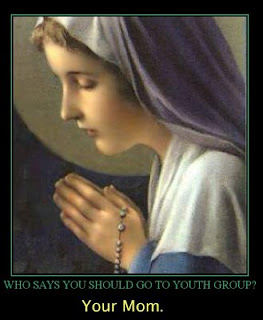
Alive and Young does it again. Truly moving. I should print this out and keep it for my kids when they get older.
{ }
by frival
on March 19, 2007
From CWN:
Rome, Mar. 19, 2007 (CWNews.com) – Italian newspapers are once again reporting the imminent release of a papal document broadening use of the pre-conciliar Latin Mass. Vatican officials remain silent on the topic.
The daily Corriere della Sera reports that a motu proprio by Pope Benedict XVI (bio – news) could be promulgated by Easter or soon thereafter. Corriere della Sera says that no date has been set– contradicting reports from other outlets saying that the document could appear on March 25, the feast of the Annunciation, or on Holy Thursday, April 5.
Another Italian daily, Il Tempo, gives Holy Thursday as the likely publication date. The paper reports that in the document, Pope Benedict will declare that the Latin Mass should be made available wherever a congregation of at least 30 people request it.
La Stampa offers yet another prediction, saying that the document will make its appearance between March 25 and Easter Sunday.
Vatican officials, in recent statements about the motu proprio, have consistently said that the timing of the document’s release is in the Pope’s hands, and no date has been set.
When you stop and think about it, even today, the Solemnity of St. Joseph, could have been chosen for very good reasons, considering that he is Patron of the Universal Church. I get the feeling the Pope is taking a page from the book of Pope John XXIII, who gave no warning before he convened Vatican II. By allowing the winds of complaint their time and showing the strength of patience, the Pope has taken the ferocity, the “newness” of their complaints away – in effect he has blunted their edge.
I should be rather surprised if he does pick Holy Thursday to sign and publish the Motu Proprio given the upheaval, or rather distraction, it would likely cause. That is precisely what the Pope would otherwise have shown to have carefully avoided and to turn it about in that way would be rather surprising. But once again, this Pope seems a step or two ahead of just about all of us. And that, my friends, is a very good thing.
Update: Drew at Holy Whapping seems to agree with me on the timing. He also points to Fr. Z’s assessment of the state of the Motu Proprio. By the way, Fr. Z’s feed has moved.
{ }
by frival
on March 19, 2007
Gerald has posted a very in-depth commentary by F.P. Barbieri on recent and not-so-recent French history as well as a rather sweeping indictment of some of the comments by Abp. Marcel Lefebvre, founder of (F)SSPX. One reason I bring this up is that it is so fundamentally different from the view given in all the history courses I took growing up, including one called “Modern European History” whose focus was primarily on getting us to the French Revolution so that we might realize that this was the epitome of civilization. One does wonder…why, if that conclusion is so iron-clad, is any discussion of an alternative interpretation of history so quickly discouraged and roundly condemned? A surprise? I think not…
{ }