…inevitably more will be provided for them. Please pray for the Chaldean Archbishop and all the Christians in the Middle East. And offer up a special prayer for the repose of the souls of those killed in the attack. Tonight is apparently not a night I will go to bed with a smile on my face…
CNA has a story that is part of a bigger issue that has caused me no small amount of heartburn in recent times:
Little Rock, Arkansas is the latest diocese asking its members to halt their support for the Susan G. Komen Foundation due to a portion of their proceeds being given to Planned Parenthood, the largest abortion provider in the United States.
…In a February 4 statement, Little Rock diocesan administrator Monsignor J. Gaston Herbert addressed Catholics as a way to inform them of the ties between the Komen Foundation and Planned Parenthood.
“Due to its policy allowing affiliates to offer financial support to abortion providing facilities and its endorsement of embryonic stem cell research, and the continued denial that abortion may well lead to the development of breast cancer, the Respect Life Apostolate neither supports nor encourages participation in activities that benefit Susan G. Komen for the Cure.”
It’s not that I’m desperately attached to sending money to the Komen Foundation. What saddens me is thinking about all those women who have unwittingly donated indirectly to Planned Parenthood. Is that an overstatement? Far from it. Money, once it goes in to a sufficiently large organization, becomes an essentially fungible resource – meaning in this case that you cannot donate money to one cause without it indirectly becoming a donation to another cause whether you want it to or not. That’s one of the most disconcerting parts about donating to a large foundation – you just don’t know for sure where all the money goes without a considerable amount of research.
The reply from the Komen Foundation is a classic example of modern relativist and consequentialist thinking:
Rebecca Gibson, a spokeswoman for the Komen foundation, told the AP that the group invested $69.6 million in more than 1,600 community-based education and screening programs during 2007. Of that, Planned Parenthood accounted for less than 1 percent of the funding, she said.
“It’s insignificant in relation to all of the funding we do,” Gibson said. “I think it’s just really unfortunate undue attention is being shed on organizations that are providing vital services in those communities.”
That boils down to “we don’t donate them that much money so stop worrying that we’re helping to fund an untold number of abortions”. Will people like this ever understand that you can never do evil that good may come of it? It’s simply not an option. Perhaps someone should mail a few thousand copies of the Summa to the Komen Foundation so they can learn some proper Thomistic principles…
…Catholic style. Diane makes a very interesting analogy, and I can’t say at all that I disagree with it.
As long as man has had the ability to launch something, battles have often started out with a “softening of the target”. In the battle of Gettysburg during the US civil war, artillery pounded the position of enemy soldiers for some time before troops marched across the field. To put soldiers on the field before the target was softened, would put them at far greater risk, and reduce their overall effectiveness. In medievil times, anything that could go into a trebuchet would be hurled against a castle before men would try to scale the walls. Even tallships would come up along side each other and let their canons blast away at each other from a very close range before men would go across in hand-to-hand battle on the deck. In modern times, targets have been softened by air and by sea.
…
My strongest belief is that the attraction of so many young people into contemplative, monastic, cloistered communities, is that they are being called up to participate in “softening the target” with the artillery of their prayers and sacrifices. The modern world could not possibly comprehend this because it is not only counter-cultural, but requires faith to grasp. It cannot be measured, nor can it be purchased. Hence, to the world, things such as prayer and sacrifice have no value.
I’ve said before, if I weren’t married with kids I’d probably be in a Trappist monastery somewhere (or Cistercian, Dominican … who knows). Regardless, I would love to see more artillery here in New Hampshire, and as well more attention given to what we do have already. The people need to know they’re there, that it’s still a lifestyle that is available, and indeed, desirable – and they need it in more than a couple column-inches in the bulletin. How? I don’t know, but it needs to be done.
Dr. Ed Peters brings up a very interesting point as regards the issue of National Catholic Reporter correspondent Joe Feuerherd’s call for the damnation of the Bishops of the U.S. before he would vote for anyone but a Democrat:
Feuerherd’s words of contempt were not shouted in a heated argument wherein, say, a lack of time for reflection or “anger hormones” might mitigate one’s culpability for uttering invectives. No, Feuerherd’s curse, “the bishops be damned”, was expressed in cold, deliberate, prose intended for maximum effect in a prominent national publication.
Now, Canon 1369 of the 1983 Code of Canon Law states that “a person who . . . in published writing . . . expresses insults or excites hatred or contempt against religion or the Church is to be punished with a just penalty.” Canon 1373 states that “a person who publicly incites among subjects animosities or hatred against the Apostolic See or an ordinary because of some act of power or ecclesiastical ministry . . . is to be punished by an interdict or other just penalties.”
Yes, that’s right, he’s suggesting that for this statement Mr. Feuerherd is facing an interdict, i.e. exclusion from the sacraments including from Christian burial. That might sound awfully harsh to the modern sensibility which is so accustomed to being told to “just get over it”. Isn’t it indeed possible though that one of the greatest problems the Church has had in the last forty years has been its overly-indulgent willingness to “just get over” anything that might be uncomfortable?
We tend to think of that problem purely in terms of homiletics, catechetics and pro-abortion politicians these days. We also know those as categories of “bad, but they’ll never get better”. This, however, isn’t in one of those hardened, well-defined categories of “post-Vatican II problems” that by now everyone knows the song-and-dance to. Yet the Church in Her law tells us this is a serious issue and one to be dealt with swiftly, with care, and clearly. Perhaps if we start treating all of our laws, rules, regulations and precepts with the weight with which they were promulgated people might stop thinking the Church only takes a precious few issues seriously.
But doesn’t this mean we’ll start looking like the big bad bullies? Sure, to some out there. Then again, anyone who perceives the Church as a big bad bully after evenly applying her law was already prejudiced in that direction and merely looking for an excuse. Eventually the Church will have to stop dodging the fight with modern mentality by being “pastoral” and walking around with a perpetually bloody nose – you don’t always need to punch back to fight a bully, just make it clear that an empty-headed threat or attack will not deter you from the Truth. If ever there were a case where the Bishops could make the point that they are not a free-fire zone without causing a major political ruckus, this would be the one. Will they? Time will tell. Even if they don’t, it’s a guarantee they’ll have another chance in time – this is not the type of problem that goes away by wishing and ignoring.
Jean from Catholic Fire, as my kids would say, “rocks!” Here are two important efforts we have the opportunity to support.
The ONE MILLION ROSARIES FOR UNBORN BABIES prayer event is scheduled to take place in the U.S.A. on Saturday, May 3rd, 2008. Participants will pray the Rosary within the same hour for an end to the surgical and non-surgical killing of unborn babies. The Rosary may be prayed at a Catholic Church, at one’s home, etc. The Saint Michael the Archangel Organization, located in Memphis, Tennessee, is coordinating this nationwide prayer event. To learn more about this prayer event, including how to register as a participant, go here.
And second:
I am inviting all my readers, wherever you live, to join in the novena from your churches and your homes. Please encourage other Catholics to participate in this Novena. While the abortion industry is being investigated by two Grand Juries, we must pray for an end to abortion. The details are below for those in the Wichita area. However, any Catholic can join us in this Novena. The intention is “To End Abortion at Tiller’s Now . . . & Abortion in Wichita Forever.” It’s easy: Just say the Rosary for the 9 days from March 7 to March 15th. If possible spend an hour each day praying in front of the Blessed Sacrament. Offer the Stations of the Cross for this intention.
Looks like it’s high time to start wearing out those rosaries, folks.
The latest thing making its way around St. Blog’s is the new website Catholics Come Home. I’ve poked around some, albeit not as much as some others and found that for the most part it’s a pretty good site. There are separate sections for “fallen-away” Catholics and non-Catholics as well as answers to many of the most common questions asked. The video production and artwork looked top-notch, which is critical – you gain or lose a viewer in the first five seconds on your site these days.
One thing I have to say … this site reminded me of the familiar refrain every Christmas and Easter – “imagine if it was like this every Sunday”. Yes, imagine. Let me put it in their words:
If even 10% of the 42.7 million inactive U.S. Catholics respond to these ads, 4.2 million Catholics could come back into the Church. The impact that 4.2 million more faith-filled, sacramentally fortified Catholics would have on society is mind boggling. In addition, if vocations are approximately .066% of the Catholic population, this program could also create 2,772 new priests!
God gives us the tools – it’s up to us to use them. This looks to be, at the very least, another tool we desperately need.
Smile. There is simply no better news than that which we have received from the Apostles through their successors. The Good News is a good as it could get, and it’s true. Remember, your smile is like two arrows pointing up to Heaven – perhaps at the sight of your joy someone may just be brought to contemplate the cause of our joy. So simple, so quick, so effortless, so powerful. So smile – you never know, it could save a soul.
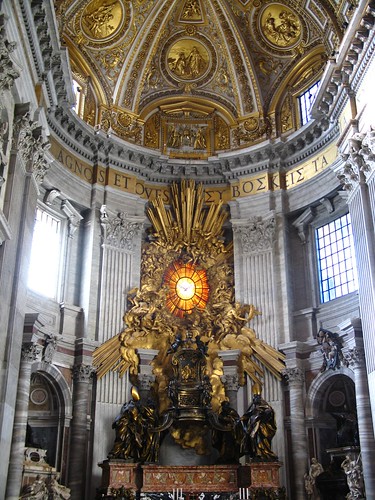 Today’s feast has always had somewhat of a personal connection for me, what with being named Peter and all. Long before I knew even what the Catholic Church was or how many different denominations had come and gone over the years I knew there was something special about this man with whom I shared a name. The very first time I read Matthew 16:18 – “[a]nd so I say to you, you are Peter, and upon this rock I will build my church, and the gates of the netherworld shall not prevail against it” – I knew it was this Church I had been seeking.
There are a veritable plethora of resources to which I could point you, dear reader, regarding the importance of the office (and hence the chair – think of it as representative of the office) of Peter and his successors. If you don’t know them already first look at these Bible verses, then hit up some of the deeper Catholic resources. Catholic Answers is a great resource, as are Catholic-Pages and Catholic Culture. But let’s move on to those Bible verses:
First, Luke 22:31-32:
“Simon, Simon, behold Satan has demanded to sift all of you like wheat, but I have prayed that your own faith may not fail; and once you have turned back, you must strengthen your brothers.”
There are further examples of Peter having the lead in the company of the Apostles:
- In Matthew 16:16 we see Peter correctly identify Jesus as “the Christ, the Son of the living God”, leading to the statement of Jesus with which I started this post. Jesus’ reply is extraordinarily telling: “Blessed are you, Simon son of Jonah. For flesh and blood has not revealed this to you, but my heavenly Father.” Peter has been confirmed by the Father for a special mission.
- In Acts 1:15 and following we find Peter taking the lead of the Apostles in the appointment of Matthias, the successor to Judas. This is a perfect example of the role of the Pope – to strengthen and to lead; Peter calls for the appointment, the Church prays and acts as one.
- In Acts 2 we have Pentecost. Indeed, the tongues of fire came to rest on “all of them”, but in Acts 2:14-40 we see Peter is the one who speaks for the Apostles giving what could be called the first homily.
If nothing else, these should whet your appetite even if you are one who does not believe in the primacy of the office of Peter. While I’m not much of an apologist, these arguments and the host more that follow from them are enough for me to know this much: Jesus founded a Church with himself as its immovable cornerstone and grafted Peter into Himself that he and his successors might become a rock of stability in all that would come to face the Church. It is, simply, something only God would have thought to do.
PJP said it perfectly at Recovering Our Catholic Patrimony (aka RCP): “I’ve been in La La Land lately, letting Lent take me by surprise and excusing myself by blaming a self-induced dark night.” I have never been so utterly blasé, or at least not felt so, about Lent in my now nigh-eleven years of being a Catholic. Even in the years when I was busying myself with being a less-than-serious Catholic Lent meant something to me and I at least gave it a good college try.
This year? I’ve felt, since the beginning of Lent, like I’d been kicked in the teeth, left out to dry in the sun and shiver in the cold. Not the heart-wrenching, gut-twisting pain of rejection but the equally crushing emptiness of utter disinterest. I knew Lent was passing me by and if I kept at it I’d completely miss Easter too, but no matter what I tried I just couldn’t get myself to get after it. Praying the Liturgy of the Hours I’d find myself at the end of a Psalm not even remembering what I’d just read; praying the Rosary I’d snap to and realize I had no idea even which mystery I was supposed to be contemplating. Being every inch the American that I am, I was sure that if I just stayed at it and did more, harder, longer I’d get back in it – or maybe I would Rambo myself into it, getting so peeved that I ripped down the walls with my bare hands and pulled everything out in the end. Maybe even with big explosions in the background just for giggles.
Idiot.
That’s not how it works, now is it? Nope, not one single bit. Nobody gets to storm the walls of Heaven and climb over. The door is simply opened for you, if you’ll but walk in.
This morning, I know not why, God decided – as I said in the comment at RCP – to apply some 2×4 theology squarely to my cranium. I think he got a good sliver lodged in my soul while he was at it too.
Why is it we have to learn the same lessons over and over again, even the ones that we ourselves teach others – sometimes even while we are teaching others that very lesson? I don’t entirely know; perhaps it’s because, as we so often jokingly say, God has a peculiar sense of humor (which, being God, it would have to be peculiar in the sense of “distinct from all others” since there is indeed only one God). More to the point, however, is the simple fact that even those of us who help educate others in the faith are still sinners with an incomplete grasp of what’s good for us. It doesn’t matter how many times you say that last point if you don’t really internalize it. And internalizing things was really at the heart of the whole thing.
To some number of people out there I’m seen as a sort of “leader” in how things “should” be done. Not, likely, anyone who “counts” in the big scheme of things, but there are those who look to my example no matter how much I might wish they didn’t. And you know what? That’s a darned hard thing to deal with sometimes. You find yourself doing things you once enjoyed and got a great amount of spiritual benefit from so that you can be seen doing them that others might be strengthened in their own path.
Before you remind me of the passage telling us not to do things that we might be seen, be honest with yourself – there is someone out there to whom you look up and lean on in some way as a guidepost. That person, more than likely, has figured out on some level that there is someone who watches them and unless they’re a saint (and perhaps even if so) that knowledge weighs on them from time to time – sometimes pulling them forward when they would like to slack off, sometimes pulling them down by distraction. I’ve been told by some out there that they see an example in what I occasionally do, so they’re out there whether I like it or not (some days I do, some days I don’t … and some days I do a little too much). The Lord knows I have not been a model to follow in the past few weeks.
For a reason as yet unknown to me God chose this morning to lift that veil. Strangely, for one so accustomed to long flows of words (exhibit A being the long winding path to get this far in this post) I’m not quite sure how to put it. Suffice it to say the message was simple: don’t just say the prayer, live the prayer – rediscover that joy of truly active participation of your entire self in the prayer. Perhaps that sounds a little New Age-ish, but that’s more from a lack of sufficiency on the part of the author than anything else. We are reminded in a most eloquent way in the Extraordinary Form of the Mass that active participation in prayer consists most properly in far more than the reading and recitation of words – we must bring that prayer into our hearts and present both the prayer and ourselves to God as an offering together. Merely reading, merely saying the prayer is nothing as compared to truly making it an offering.
The funny thing is, I’ve told people exactly this before, but for whatever reason it never sank in quite as it did this morning. Every day during Morning Prayer I try to imagine Zechariah proclaiming the Benedictus – sometimes I get close, sometimes, well, not so much. This morning, I knew the joy which burst the bonds of his tongue as he proclaimed “Blessed be the Lord, the God of Israel“. Blessed indeed!
I have to admit – this corner-turning makes me a little afraid. Afraid because I haven’t been given this kind of clarity in a long, long time. The last time this happened, well, the issue of vocation was involved. And if I’m hearing what I think I’m hearing, frankly, it scares the life out of me. Maybe I’m wrong, maybe this is just a light shone in my darkness, I don’t know. At least I like long sleeves, so there is that. It’s funny, because when I was contemplating the priesthood it didn’t scare me at all; perhaps it’s the wisdom that comes with age, but … Lord, Thy will be done. I am, without question, without doubt, without qualification, unworthy of whatever it is to which you call me.
Fr. V at Adam’s Ale asked whether he should be preaching on pro-life issues or if it would be a case of “preaching to the choir”. My comment is below:
Simply put, you have to preach to the choir – every choir needs a director no matter how well they know the music. A well-tuned ear teaching with a single voice can bring a greater cohesion and clarity than any ad hoc collection of even the most talented and well-intentioned players.
Do most (I hope most, anyway) of us know that the pro-life issues are of critical importance? Sure. Do we have the theological background with which to create a consistent platform from which to speak? Most of us do not and even those who do should appreciate the insights a different perspective brings.
Most of all, I think, if you don’t talk about it people will think it’s not important. Someone once tried to tell a RCIA class I was teaching that Humanae vitae was not important because you never heard about it from the pulpit. If a catechist gets that message, think about how many others do as well.
Yes, preach to the choir. Absolutely, and without reservation. I tell you simply, even if I’ve heard the tune before, the beauty of Truth will always be music in my ears, bring a smile to my face and renew both the love and the determination in my heart.
As a postfix … speak, because the next pro-life homily I hear … will be my first.
I can’t begin to tell you how much it hurts to have to write that last point. It needs to be a constant reminder to priests and seminarians that the homily is for both education and edification. Just because we know it, doesn’t mean we don’t need to be reminded of and reinforced in it.
There is no such thing as a throw-away homily. I know that probably seems like an unfair statement, that I expect too much from our priests. You know what? You’re probably right – I do. All I really want, though, is for them to always have before them that they act in persona Christi and present to those around them a unique imago Dei whether they feel like it or not. An impossible task? By yourself, sure. That’s why it’s so critical for priests to remember that they do not act purely of their own capacity and grace, but that of Christ himself. Several old standby sayings come to mind here: “Let go and let God”; “Pray more, preach less” are but two of them.
Before you go away thinking I ask the impossible and expect it all to be done with no fanfare or thanks … Remember this as well: for every person who does come or write to thank you there are ten or twenty more who simply don’t have the words. And on this topic, perhaps your most grateful audience can’t even speak … yet. To all the priests out there, I offer my thanks and prayers – through your hands thousands of thousands of graces have been set free, and through your words untold lives have been saved and souls saved. For it is not you who act, but Christ who acts in you. Deo gratias…


