Yeah, work is kicking my keester and I’m feeling perpetually further behind than I was the day before. But I’ve got nothing on this. ‘Scuse me, I have to go admit that I’ve got it easy to a few people.
If you, like me, have never heard of Ember Days you’ll want to read this article at Rorate Caeli. It’s a reprint of an article by Michael P. Foley from The Latin Mass Magazine. After reading it I feel, in a way, as if I’ve been robbed of some of my patrimony all these years. There is still too much of a “we threw everything out with Vatican II” attitude and all too often people glibly state that “we don’t do that any more” neither knowing why we did it before nor why we do it now. History is a powerful teacher, if only you are willing to learn.
Update: I’m way behind (again) on my blog reading, or I’d have known to include a pointer to this post at NLM. So much about Ember Days I never knew, so much to have missed…
Today we pray for Deacon Paul Boucher and Deacon Richard Shannon.
Deacon Boucher was ordained in 2002 and serves at St. Mary’s Parish in Claremont. He also serves on the Diocesan Lay Ministry Formation Commission.
Deacon Shannon was also ordained in 2002 and serves at the Parish of the Transfiguration in Manchester. He also serves on the Diocesan School Board.
May they find their inspiration in the example of St. Stephen who gave all he had to the Church and in our mother Mary who loves and watches over all who serve her Son.
Okay, I admit it. When I saw this book on the list of possible books for review from Catholic Company I just about jumped out of my seat. I haven’t met a book by Mike Aquilina yet that I haven’t found both intellectually and spiritually stimulating. This one was no different.
It’s a fairly slim volume, tipping the scales at 188 pages including references. A good number of these pages are accented by beautiful artwork by Lea Marie Ravotti; a book on symbols cannot survive without good artwork and this work does not disappoint. I’ve seen a couple of quibbles over the use of a relatively fine font combined with a medium brown ink. When I first opened the book I said, “oh yeah, I see what they’re talking about”. Then I started to read it. In the end analysis I’ll say this: it may take a couple of pages to get used to it, but as long as you’re not trying to read it by candle light by the time you’re out of the Introduction you won’t even notice it. And that’s from someone who is destroying his eyesight by staring at a computer screen for eight to twelve hours a day for a living.
As important as the aesthetic of the book may be, without content it would be a niche intellectual object. Content, however, is not a problem for this book. In fact, I am in complete agreement with the author’s plaintive cry in Chapter 1:
Few of us today, however, can even begin to understand the messages left for us by our ancestors. We have lost our Christian mother tongue – the code of the martyrs – and we are impoverished by the loss. They have become like hieroglyphics, a language that only academic specialists understand. What is worse is that we have forgotten how to think the way these distant ancestors thought, and this has rendered them even more remote from us. Their symbols seem incomprehensible now.
Yet delivering the message was, for them, clearly an urgent matter, a matter of ultimate consequence. To carve or paint or scratch these symbols, they burrowed into the ground and breathed foul air while laboring in dim lamplight. Our ancestors did this so that their message might reach us. We owe them at least the effort of a sympathetic study.
We do indeed, and this volume is an excellent start. By turns intellectual, historical, philosophical, academic and spiritual it lays out for us a world all together too many of us take for granted when we even acknowledge its existence at all. We have, by and large, lost the use of this language and that is only to our detriment.
I can say that within only a page or so of the first symbol explored in this book I was thinking “now there is something I can use with our RCIA class”. The book is not so simple as to be redundant for all but the true patrologists out there, nor is it so complicated as to be over the heads of those with a thinner Christian formation. It is clear that Aquilina is not only comfortable with his subject matter but fluent in it. There is a point at which one becomes sufficiently steeped in a topic that conversing about it no longer requires complex explanations and stiff wording. No, in this topic the author is closer to conversational in tone which makes for a very comfortable reading even as the reader works his way from the author’s words to a quote from a Church Father to a quote from the Bible and back again. It is a rare treat to read a book this informative that is simultaneously this fluid.
In my last review I said I was going to buy a copy of the book for myself since I had received an unbound galley copy; this copy was “the real thing”. This time, though, I’m going one better than before. I’m not buying another copy for myself, I’m buying one for our RCIA director. If you know me, you know it’s a rare thing indeed for me to buy a book for someone else; the last time I did that it was Pope Benedict’s Jesus of Nazareth so Mike Aquilina is in good company here. Does this mean I’d recommend this book to someone else? Absolutely, and for this price it’s an absolute steal given how much you will learn. Buy it, read it, learn something about your faith. Then read it again and learn something else. Yeah, it’s that kind of a book.
This review was written as part of The Catholic Company product reviewer program. Visit The Catholic Company to find more information on Signs and Mysteries-Revealing Ancient Christian Symbols .
Today we pray for all deceased priests and religious of the Diocese. I remember in a special way Fr. Denis Horan, my first Pastor, and Bishop Leo E. O’Neil, the Bishop who welcomed me into the Church.
Requiem æternam dona eis, Domine, et lux perpetua luceat eis. Te decet hymnus Deus, in Sion, et tibi reddetur votum in Ierusalem. Exaudi orationem meam; ad te omnis caro veniet. Requiem æternam dona eis, Domine, et lux perpetua luceat eis.
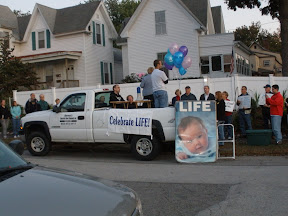
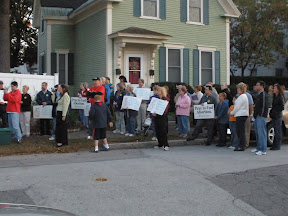
For the first time since its inception, 40 Days for Life is in New Hampshire. Last night we held a kickoff rally outside the Planned Parenthood abortuary in Manchester. It was, in a word, powerful.
All told, I’d estimate around 60-70 people showed up – maybe more by the time things really got going. Before they rally started some people were handing out St. Michael the Archangel prayer cards (and how appropriate the line, “Be our defense against the wickedness and snares of the Devil”, he who is ultimately behind this menace) and the Prayer for the Conversion of Abortionists by Fr. Frank Pavone. Things started shortly after with prayer and then witness from three different individuals, each with a different story. (Click on the picture for a larger version.)
 |
The woman speaking in the above picture is the one who came to our parish this past weekend. She told of how she waited and prayed day after day for God to send someone to bring 40 Days for Life to New Hampshire (boy, that sounded familiar…) until finally one day she realized that just maybe God had put her in that place at that time for that very purpose. What a powerful reminder that each of us has an irreplaceable role to play in this world – one God has laid out for us that no one else can do.
The woman in the back whom you can just see holding flowers is a sidewalk counselor who came to speak to us from Massachusetts. Her message was simple – pray, and be a witness, because you never know who is watching or what will happen if you put yourself out there. And above all, trust in God even if you don’t know how He is going to provide for you. She shared with us a few stories of times on the sidewalk when she had to step out in faith before she knew how things would work out and when she did God responded in a big and unforeseeable way.
The young man in the front of the truck spoke last, and his story was short but powerful. He is the father of a child aborted against his will. He told us of how when he called Planned Parenthood to ask them not to go through with the abortion he was told flatly that he had no rights in the matter and that’s all there was to it. The dimming sunlight reflected off no small number of tears as he spoke.
 |
| One side of the crowd |
 |
| The other side of the crowd |
After the witnesses were given we, again, prayed some more. We then made a candle light procession in front of the abortuary, singing Amazing Grace, turned around at the Elm Street intersection and processed back to where we started again. We had time to briefly chat with some friends and acquaintances as sign up sheets were handed around for anyone who could commit to at least an hour’s quiet, prayerful witness.
Yes, if you’re curious, we did have one heckler yell out “choice!” as he drove by but, well, it took a minute to even figure out what he (yes, “he”) said as he didn’t make much of an attempt at either enunciating his opinion or even yelling in our direction. There were also a couple of girls in nurse outfits standing by the back of the abortuary using their cell phone cameras to record the procession as they laughed and giggled. I can only guess that they work there and have simply no idea what they are doing or the pain and harm they are causing. They were, in a way, among the first people to see the power of 40 Days for Life, even if they don’t yet realize it. Those two young girls have never left my prayers from that moment on.
Sometimes I feel funny writing a review about books like this
Just because, and because it seems like this topic comes up now and again I thought I’d include his reflection on a topic that cannot help but be a hot-button. Even so, you notice right away the now-familiar combination of depth of knowledge, orthodoxy, and pastoral sensitivity – a combination we all would do well to emulate
Thus, for example, in the writings of William of Auvergne we find him making the distinction by which outward and inward communion are connected as are sign and reality. He then explains that the Church would never wish to deprive anyone of that inner communion. When she wields the sword of excommunication, then, according to him, this happens only in order to heal the spiritual communion with this medicine. He then adds a thought that is at the same time consoling and stimulating. He knows, he tells us, that for not a few people the burden of excommunication is as hard to bear as martyrdom. But, he says, very often a person makes more progress in patience and humility as an excommunicate than in the situation when he is outwardly in communion.
That deserves some not-inconsiderable chewing on. The man just makes you think – we are indeed blessed to have him as Pope.
Today we pray for Rev. Jonathan DeFelice OSB and Rev. Paul Riva CSR.
Fr. DeFelice OSB is the President of St. Anselm College in Manchester, New Hampshire, a position he has held since 1989. He entered Saint Anselm Abbey in 1968 and professed solemn vows as a Benedictine monk in 1973. He was ordained a Roman Catholic priest in 1974 after studying theology at Saint John’s Seminary in Brighton, Mass.
I am, sadly, unable to find any information on Fr. Riva aside from his residence in Suncook, New Hampshire.
May Mary draw them ever closer to her Son, and may they always find inspiration in the life and works of St. John Vianney, the patron saint of diocesan priests.
…is teach my kids how to not only say the Rosary in Latin but to chant it as well. Hey, you know, in for a penny in for a pound and all. Well, with a hat tip to Rich Leonardi, I have a good start finally.


