Fr. Barron on religious “drifters”

I once proposed a paper for my senior English thesis dealing with the role of organized religion in an individualistic society.  I was told that the modern society was not individualistic but rather formed of a series of group-think and peer-pressure groups.  Lo these many years since, and look where we have come.

YouTube Preview Image

Bring it with you

The other day I was sitting in an office waiting, as were many of my co-workers, to find out whether or not we were still employed (thankfully all those I know directly still are although a good many were not so lucky) when a co-worker dropped in the office to chat away some of the time.  Being the “horizontal organizer” that I am, I’d spread out my belongings across a good swath of the desk even though I was just borrowing it for the day.  Some day I’ll figure out how to be organized.  Honest.

As we chatted about mostly nothing he happened to notice the ribbon markers in my Liturgy of the Hours and asked if it was a Bible.  Since most people that see a book with ribbon markers think it’s a Bible that didn’t surprise me.  Now mind you, usually I’m the shy type and would respond to the question with a quick mumbled dismissal and then stuff the book in a bag to avoid the rest of the conversation.  This time, for whatever reason, I explained what the book was, how the LotH works and its history.  Come to find out he’s Russian Orthodox so we went looking to find out if the Orthodox have a complement to the LotH (answer: kind of, but not as universal as the LotH is in the Western Church).  During all this we discussed morality, politics vis-a-vis religion, the intersection of the Orthodox and Catholic Churches, the differences between the pontificates of Benedict XVI and John Paul II, ecumenism and other topics I’m quite sure I don’t even remember.  And all this time I was quite sure that most of the people I worked with were, at best, disinterested agnostics.  Fine judge of character I turned out to be.

So what’s the moral of the story?  First, don’t assume you know people too well too quickly – it’s usually to your detriment as well as theirs.  Second, there are more of us out there than we sometimes like to think – “us” being those who have a more-than-passing interest in the Christian Faith.  Third, don’t be afraid to live your faith publicly – the people you’re afraid of offending might just be looking for someone to talk to and you might be their only chance.  John Paul II was right when he started his pontificate with the fine words, “be not afraid!”

Fr. V made a very cogent point which I can only believe needs more emphasis in our culture. In discussing the Cleveland school shooting, he said (emphasis mine):

Apparently there were many signs that this kid was headed for trouble (as it seems there almost always is.) True freedom would still exist for that boy and the people he shot had community been more cohesive and concerned about the young man than being afraid of trespassing on someone’s business. That is the basis of the community of Church. It is the basis of true freedom. It is us and God, not me and God.

Doesn’t that just go against everything we hear our secular leaders talking about these days? That we must be more respectful of others’ privacy to the point of denying them the ability to share in our own lives – that religion that is not strictly private and internal is degenerate, malformed and dangerous? Yet Christ tells us to reach out to others, to bring His hand of healing to where it is needed most. If this poor soul had known the love God has for him, I truly doubt he would have been capable of what happened. In the final analysis this one does, to a great extent, lay on us folks. Sure, that’s overly harsh and judgemental – it is also, however, largely true and an attitude the Church Fathers would not find surprising. So think about that, the next time you have a chance to expound on your faith and are tempted to shy away for fear of “trespassing on someone’s business”. It just may save a life some day.

Possible meeting between Pope and Russian Patriarch?

From CWN:

Mar. 1, 2007 (CWNews.com) – A Russian Orthodox prelate has told reporters that a meeting between Pope Benedict XVI (bionews) and Russian Patriarch Alexei II could take place this year.

Bishop Hilarion of Vienna, who is representating the Moscow patriarchate at a planning meeting for the joint Catholic-Orthodox commission on theological dialogue, said that a meeting between the Pope and the Patriarch would be likely to take place at a “neutral” location, rather than in Russia or Italy.

“It is difficult for me to say when such a meeting could take place,” said Bishop Hilarion. “I think that it could happen shortly, should there be a mutual desire to meet and a common understanding of the fundamental questions.”

For several years, Catholic officials have sought a “summit meeting” between the Russian Patriarch and the Pope. Although concrete plans have been discussed on several occasions, in each case the Moscow patriarchate broke off the discussions, saying that a meeting could not take place until the Vatican renounced “proselytism” by Catholic clerics in traditionally Orthodox lands such as Russia and Ukraine.

Bishop Hilarion told reporters, however, that the prospects for a meeting are now better. “Dialogue is moving forward,” he said, on the issues that have caused disagreements between Rome and Moscow. “We are moving in the right direction,” he said.

The Orthodox bishop added that while a first meeting would probably take place outside Russia, he saw a later papal visit to Moscow as a possibility. “Alexei has said many times that a papal visit to Russia is possible,” Bishop Hilarion.

The Russian prelate said that he had no way of knowing whether President Vladimir Putin will invite the Pope to visit Moscow when Putin travels to Rome for a meeting with Benedict XVI on March 13.

Bishop Hilarion noted that another major event in Catholic-Orthodox dialogue will take place in October of this year, when the joint commission for theological dialogue meets in Ravenna, Italy. He said that Pope Benedict XVI and Ecumenical Patriarch Bartholomew I of Constantinople will attend that meeting.

The Vatican has not confirmed the Pope’s participation in the Ravenna talks. Informed sources have reported that Patriarch Bartholomew asked the Pontiff to join him in attending the October meeting, when the two men met in Turkey last November 30. Pope Benedict reacted favorably to the idea, the sources say.

Even just a meeting between the two would be a truly momentous occasion. As the article suggests, it has been a long time since the Vatican and the Russian Patriarchate have been on “good terms”, if you will. I it rather ironic, don’t you think, that this Pope whom the cognoscenti in the press thought would be so divisive has had such a positive impact on the unity of the Church as a whole. The good thing is he’s approaching this from a true spirit of ecumenism, rather than the “I’m okay, but you’re better” approach that has dogged any ecumenical efforts for so long. I’m very curious to see where this goes, even though it’ll probably move at the glacial pace most things ecclesial do.

Strong words at the Papal retreat

Argent, quoting Zenit, gives us the scoop on Cardinal Biff’s preaching at the Lenten Papal Retreat. People had expected strong words, and the Cardinal did not disappoint.

Quoting the work “Three Dialogues on War, Progress and the End of History,” Cardinal Biffi told his listeners that “the Antichrist presents himself as pacifist, ecologist and ecumenist.”

“He will convoke an ecumenical council and will seek the consensus of all the Christian confessions, granting something to each one. The masses will follow him, with the exception of small groups of Catholics, Orthodox and Protestants,” he said.

Ouch. But if you thought that was harsh, he was much more incisive later:

The 78-year-old cardinal said that if Christians “limited themselves to speaking of shared values they would be more accepted on television programs and in social groups. But in this way, they will have renounced Jesus, the overwhelming reality of the resurrection.”

Not just ignored Jesus – renounced Him. The Cardinal makes the strong point that ecumenism can be a good, but it can (and has, if you read between his lines) been taken too far. Honesty is a practice of God, not equivalence.

Particularly interesting is Catholic Mom’s take on this. She notes the contrast between the Cardinal’s words and those of Katherine Jefferts Schori. The Cardinal reminds us that when you’ve walked away from God the path to Him is back from where you are, not continuing down your own self-made road. So far this looks to be a very interesting choice by the Pope for this retreat.

So much for that…

Uncle Di put the kibosh on any hopes of a speedy, even if measured, unity between at least some segment of the Anglican Communion and the Roman Catholic Church. You know the old line, “if it sounds too good…”

Jimmy Akin kindly reminds me, and many others, that whenever the name Ruth Gledhill is attached to the story, count your eggs twice. Mea culpa, mea culpa, mea maxima culpa. You’d think I’d know better by now… In a roundabout way, that’s almost an appropriate reminder right before Ash Wednesday.

Now this is a rumor to start…

Against All Heresies points us to a story in the Times (UK) Online which suggests one possible fallout of the Anglican Primates meeting this week could be an eventual reunification of parts of the Anglican Communion under the Pope. What a rumor to start a Monday!

In a 42-page statement prepared by an international commission of both churches, Anglicans and Roman Catholics are urged to explore how they might reunite under the Pope.

It comes as the archbishops who lead the 38 provinces of the Anglican Communion meet in Dar es Salaam, Tanzania, in an attempt to avoid schism over gay ordination and other liberal doctrines that have taken hold in parts of the Western Church.

Were this week’s discussions to lead to a split between liberals and conservatives, many of the former objections in Rome to a reunion with Anglican conservatives would disappear. Many of those Anglicans who object most strongly to gay ordination also oppose the ordination of women priests.

In one significant passage the report notes: “The Roman Catholic Church teaches that the ministry of the Bishop of Rome [the Pope] as universal primate is in accordance with Christ’s will for the Church and an essential element of maintaining it in unity and truth.” Anglicans rejected the Bishop of Rome as universal primate in the 16th century. Today, however, some Anglicans are beginning to see the potential value of a ministry of universal primacy, which would be exercised by the Bishop of Rome, as a sign and focus of unity within a reunited Church.

In another paragraph the report goes even further: “We urge Anglicans and Roman Catholics to explore together how the ministry of the Bishop of Rome might be offered and received in order to assist our Communions to grow towards full, ecclesial communion.”

There have been rumors of Anglican reunification with Rome for probably longer than I’ve been alive, but after their decision to ordain women and certainly after the Episcopal ordination of Gene Robinson, an openly gay man living with his partner (is that the nom du jour?), it was as if ice water had been poured on the possibilities. Now it seems that rather than ice water it may well have been gasoline. If nothing else, this serves to once again highlight the necessity of proper ecclesial unity and the terribly destructive effects of the Reformation on that unity.

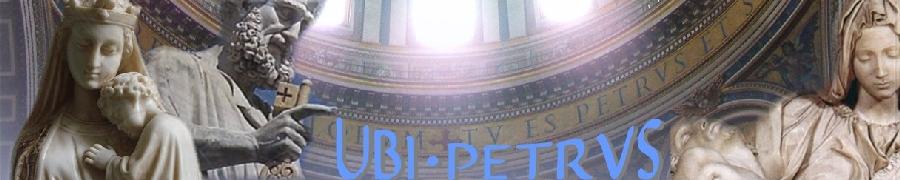
Why “Ubi Petrus?”

Ubi Petrus ibi ecclesia, et ibi ecclesia vita eterna.
Where there is Peter there is the Church,where there is the Church there is life eternal!
— St. Ambrose of Milan

Patron Saints

Saint Ambrose
Saint Ambrose, ora pro nobis!

Saint Peter with keys
Saint Peter, ora pro nobis

Our Lady Seat of Wisdom
Our Lady Seat of Wisdom, ora pro nobis

Archives

Follow me on twitter

Catholic Blogs Page

Categories