Why do we call it a “host”?

Sometimes questions just hit you, things you’ve blindly accepted without mental bother for years suddenly become a pressing question in your mind.  This weekend clear out of the blue I realized I had absolutely no idea why we Catholics call the Eucharistic bread a “host”.  It seems a word with a host … *ahem* … a plethora of potential meanings, none of which really seem to apply and some of which would lead directly to such heresies as transfiguration (which holds the consecration creates a “figure” of Jesus’s Body) and consubstantiation (holding that Jesus’s Body and Blood co-resides with the bread).  Since teaching heresy didn’t seem to be a decent reason for the word, I had to look it up.

The New Advent Catholic Encyclopedia has this, in part:

According to Ovid the word comes from hostis, enemy: “Hostibus a domitis hostia nomen habet”, because the ancients offered their vanquished enemies as victims to the gods. However, it is possible that hostia is derived from hostire, to strike, as found in Pacuvius. In the West the term became general chiefly because of the use made of it in the Vulgate and the Liturgy (Romans 12:1; Philippians 4:18; Ephesians 5:2; Hebrews 10:12; Mabillon, “Liturg. Gall. vetus”, pp. 235, 237, 257; “Missale Mozarab.”, ed. Leslie, p. 39; “Missale Gothicum”, p. 253). It was applied to Christ, the Immolated Victim, and, by way of anticipation, to the still unconsecrated bread destined to become Christ’s Body. In the Middle Ages it was also known as “hoiste”, “oiste”, “oite”.

In time the word acquired its actual special significance; by reason of its general liturgical use it no longer conveyed the original idea of victim.

Perhaps that’s all there is to it.  But somehow in Catholicism it seems the answer to a question this old never has just one string.  So… does anyone have anything else to add to this?

Baptism and the gym

Fr. Phillip Powell, OP has a simply superb homily (and would you expect anything less from a Dominican?) for yesterday’s Feast of the Baptism of the Lord.  I do think St. Dominic would be proud.  A small snip:

We start our life-long regime at The Jesus Gym on the day we are baptized. From that moment on, “the grace of God has appeared, saving all and training us to reject godless ways and worldly desires and to live temperately, justly, and devoutly in this age. . .” As Catholics, we don’t have any trouble understanding grace as divine help, a gift from God to assist us when we need it. What we do have trouble understanding sometimes is that the help we get isn’t always the help we want. Like the skinny 18 year old freshman who wants ripped abs in a week to impress his girlfriend, we sometimes approach the throne in prayer and ask not for assistance to accomplish some goal, but rather we ask God to accomplish the goal for us, instead of us. The freshman is very disappointed to hear that his six-pack will take a semester or two with lots of hard work. And we are no less disappointed to learn that grace does not prevent us from traveling the ways of the godless nor desiring what the world would have us desire. Instead, grace trains us how to be godly men and women. The hard work of chiseling out a ripped spiritual six-pack is all ours. But we do not work alone.

NH Eucharistic Conference 2009

I can think of no greater venue in southern New Hampshire to focus one’s attention on Christ in the Eucharist than under the Baroque cover of Ste. Marie’s church in Manchester.  Even the still in-progress installation of a marble floor for the spacious sanctuary could not distract those present from Him who in His Eucharistic Presence is the source and summit of our faith.

Click to continue reading “NH Eucharistic Conference 2009″

NH Eucharistic Conference 2009

I’m  going to be there.  Are you?  The speakers will be Bishop Robert Hennesey, Auxiliary Bishop of Boston, Bob and Penny Lord of EWTN fame and Dr. Hugo Poza of the hosting Ste. Marie Parish.  Mass will be offered by Bishop John McCormack, Bishop of Manchester.  What better way to spend a day and $20?

“A total re-catechesis for the sacrament of penance”

In The Catholic Spirit, the official newspaper of the Archdiocese of St. Paul and Minneapolis Archbishop John Nienstedt has proposed “a total re-catechesis for the sacrament of penance” in an article here.  He suggests this will be an ongoing series – keep a watch out for follow-up posts to this excellent beginning.

H/T to WDTPRS.

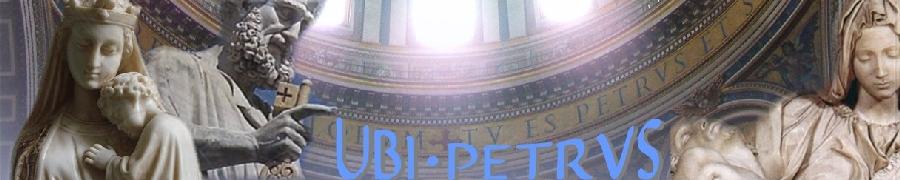
Why “Ubi Petrus?”

Ubi Petrus ibi ecclesia, et ibi ecclesia vita eterna.
Where there is Peter there is the Church,where there is the Church there is life eternal!
— St. Ambrose of Milan

Patron Saints

Saint Ambrose
Saint Ambrose, ora pro nobis!

Saint Peter with keys
Saint Peter, ora pro nobis

Our Lady Seat of Wisdom
Our Lady Seat of Wisdom, ora pro nobis

Archives

Follow me on twitter

Catholic Blogs Page

Categories