Hope for the future

Last evening I had the opportunity to attend a concert put on by the Chroale and Schola Cantorum from Holy Family Academy here in town.  The concert was held, as so many wonderful things in this city, at Ste. Marie’s church, which provided magnificent acoustics, even for those young men and women who were a little nervous in front of the good-sized crowd that had assembled.  Seeing them give glory to God in their singing, and particularly so in the many pieces of sacred music, was a truly powerful experience of hope.  When they intoned the Kyrie to start the concert I quite literally felt a chill run down my spine.

This is the future of the Church – this new generation of children and young adults growing up receiving a more full education both in the world and in the Faith than has been seen in decades, and growing up in love with Christ and His Church.  As much damage has been done in the past decades by terrible-to-nonexistent catechesis, the future looks even more bright.  Deo gratias!

The dangers of music

In an effort to get my new blogging string off to a roaring start, I thought I’d pull a draft from the archives that I didn’t quite have the guts to finish blogging before.  In all the discussions I’ve had with people from the many corners of the Catholic faith I’ve found that not even the issue of denying the Eucharist to pro-abortion politicians invokes the level of emotion one finds in a discussion about … liturgical music.

I have to admit that I don’t yet know why this is so but it seems there is some sort of innate personal identification between music and belief.  I think there are two aspects which form this identification: 1) the ages old maxim lex orandi, lex credendi (or, the law of prayer is the law of faith) ; and 2) an innate understanding that liturgical music is a part of the Mass, not added to it – that it flows from the faith expressed in the Mass and is a part of it.

But that’s not what I’m here for with this post.  I’m here to cause a little trouble with a quote from then Joseph Cardinal Ratzinger’s The Spirit of the Liturgy, a work I’d say is a must-read for anyone interested in discussing the Catholic liturgy in the modern day.  Why cause trouble?  Because he displays the question of music in the liturgy in this quote in a way that opens the discussion on both sides of the new music / traditional music divide with equal parts gratitude and remorse for those who would hold to either.  In just this short paragraph he gives everyone a great deal to think about and an opportunity to reassess old positions.  And people wonder why I’m so impressed with this Pope…  Here’s what he had to say:

As the Church was uprooted from her Semitic soil and moved into the Greek world, a spontaneous and far-reaching fusion took place with Greek logos mysticism, with its poetry and music, that eventually threatened to dissolve Christianity into a generalized mysticism. It was precisely hymns and their music that provided the point of entry for Gnosticism, that deadly temptation which began to subvert Christianity from within. And so it is understandable that, in their struggle for the identity of the faith and its rooting in the historical figure of Jesus Christ, the Church authorities resorted to a radical decision. The fifty-ninth canon of the Council of Laodicea forbids the use of privately composed psalms and non-canonical writings in divine worship. The fifteenth canon restricts the singing of psalms to the choir of psalm-singers, while “other people in church should not sing.” That is how post-biblical hymns were almost entirely lost. There was a rigorous return to the restrained, purely vocal style of singing taken over from the synagogue. We may regret the cultural impoverishment this entailed, but it was necessary for the sake of a greater good. A return to apparent cultural poverty saved the identity of biblical faith, and the very rejection of false inculturation opened up the cultural breadth of Christianity for the future.

So now, I ask you, what does it say to you?  I find great challenge for those on both sides of the debate in this writing, but I’m curious if I’m alone.  Don’t let the combox grow cobwebs…

Makes me wish I could sing…

…rather than just scare the cats and make the dog have that sad “please stop the pain” look

YouTube Preview Image

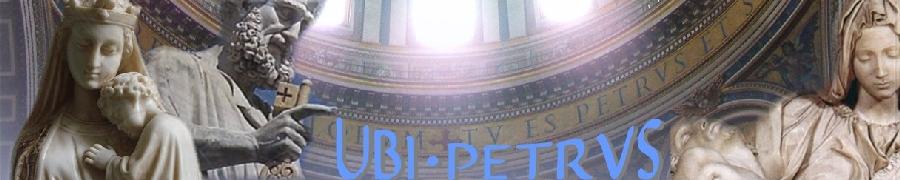
Why “Ubi Petrus?”

Ubi Petrus ibi ecclesia, et ibi ecclesia vita eterna.
Where there is Peter there is the Church,where there is the Church there is life eternal!
— St. Ambrose of Milan

Patron Saints

Saint Ambrose
Saint Ambrose, ora pro nobis!

Saint Peter with keys
Saint Peter, ora pro nobis

Our Lady Seat of Wisdom
Our Lady Seat of Wisdom, ora pro nobis

Archives

Follow me on twitter

Catholic Blogs Page

Categories