Simplicity and purity

From The Imitation of Christ, chapter 4:

A MAN is raised up from the earth by two wings—simplicity and purity. There must be simplicity in his intention and purity in his desires. Simplicity leads to God, purity embraces and enjoys Him.

If your heart is free from ill-ordered affection, no good deed will be difficult for you. If you aim at and seek after nothing but the pleasure of God and the welfare of your neighbor, you will enjoy freedom within.

If your heart were right, then every created thing would be a mirror of life for you and a book of holy teaching, for there is no creature so small and worthless that it does not show forth the goodness of God. If inwardly you were good and pure, you would see all things clearly and understand them rightly, for a pure heart penetrates to heaven and hell, and as a man is within, so he judges what is without. If there be joy in the world, the pure of heart certainly possess it; and if there be anguish and affliction anywhere, an evil conscience knows it too well.

As iron cast into fire loses its rust and becomes glowing white, so he who turns completely to God is stripped of his sluggishness and changed into a new man. When a man begins to grow lax, he fears a little toil and welcomes external comfort, but when he begins perfectly to conquer himself and to walk bravely in the ways of God, then he thinks those things less difficult which he thought so hard before.

Or, as my father would have put it, “things aren’t as hard as you’d like them to be.”

True self-surrender

Just today my wife and I were discussing people who get married just so they can be “not alone” and how, in the end, those marriages never worked.  It was, surely, no coincidence that just earlier in the day I had read this from Dietrich von Hildebrand’s Transformation in Christ (and yes, I’m finally only a few pages from finishing it):

True self-surrender … implies that we are entirely centered upon the object in which we lose ourselves.  The value of that which holds us, and by no means the pleasure of being held, dominates our consciousness.  One who seeks that pleasure for its own sake errs just as they do who yearn for the thrill of love rather than thinking of the beloved person, and hence never attain real love at all.

There is no point in our longing to lose ourselves in general.  What we should long for is exclusively to lose ourselves in Christ.  Let us never forget that, though an intense love or enthusiasm as such is undoubtedly a great experience and a fine sight, its value essentially depends on whom or what we love; on the person or thing that evokes our enthusiasm.

If I needed it, someone else might as well

No excuses, only apologies.  Life has been incredibly busy, and I have allowed it to become so.  My apologies for the length of this excerpt, but it has helped me see where I’ve twisted myself around and just maybe it can help someone else as well.  This is from Dietrich von Hildebrand’s Transformation in Christ.

Click to continue reading “If I needed it, someone else might as well”

The strength to know how to be weak

I grabbed my mother by the elbow and whispered, “is everything okay with Dad?”

“Yes,” she assured me, but the look on her face suggested she wasn’t quite telling me everything.  Mom had gone through a lot in life, not as much as many but no rose petal littered path either, and had learned to deal with things quietly by herself.  I, for my part, had learned how to figure out when she wasn’t saying what she was thinking.  Time to put on the stupid kid bit and just ask.

Click to continue reading “The strength to know how to be weak”

Here’s one you didn’t see coming

…and I’m sure the MSM wasn’t exactly going to fall all over themselves to tell the story.  Not only is Kim Yu-Na the Olympic figure skating champion, she’s a recent convert to Catholicism.  The part about the ring could well be a lesson for all of us, perhaps just a little too comfortable in our sometimes nearly-invisible faith.

Learning truth from fiction

I picked up a copy of Father Elijah on one of my recent bookstore trips (for the kids, honest!) and, as has been my practice of late, picked it up from my reading pile in lieu of some more heavy spiritual reading.  I’ve seen quotes from the book smattered here and there and while I’m not at all big on the apocalyptic genre of literature I figured this would at least be a light and entertaining read.

Let me first say that to get through this book you almost have to be Catholic, or at least quite open to the Catholic point of view across a variety of subjects – the author makes no pretense of a C.S. Lewis-esque “mere Christianity” – the main character is Catholic through and through.  To be honest, it took me a while to get used to such unvarnished expressions of orthodox Catholic faith; when I noticed this I knew I wasn’t quite getting what I had expected.  Since this isn’t a book report, I’ll condense the story to this: chapter after chapter I witnessed someone tempted and tortured, sometimes almost to the breaking point, but always falling back to find strength in Christ through his weakness.  I kept thinking to myself, “you know, I’m making this whole thing out to be way harder than it really is”.

Towards the end of the book the main character, Father Elijah, is having a rather intense discussion with an angel.  In this discussion I finally got the message.  Elijah, beaten, exhausted and spiritually worn out says to the angel, “I want to die.”  The angel replies, in a statement that struck me like a cold hand, “Now we can begin.”

For when I am weak, then I am strong. — 2 Cor 12:10

I’ve been spending these last few months trying to figure out a way to be a “normal” Catholic.  I know that for some, in particular I imagine cradle Catholics, that concept seems pretty strange.  Forget not that I spent the first twenty-some years of my life with no religious formation at all, so even as I increase my book smarts I can be downright street stupid when it comes to the day-to-day living of this Catholic life.  This all runs back to one seemingly infinitesimal event in the very beginning of my life as a Catholic.

Not altogether long out of RCIA – we’re talking months here, not years – I was invited to the rectory to have dinner with the priests at my then-parish.  It was a wonderful way to expose someone deeply contemplating the priesthood to what life is like for priests outside of office hours.  Dinner was had and we sat down to some Scotch and conversation.  I remember not how we got there nor even what the exact topic was, but I made some sort of rather flat statement of how things ought to be done – according to the book.  One of the priests laughed a bit and said, “well remember, you’re still a zealot – that’ll wear off after a while.”  A zealot – i.e. someone not quite completely sober and mature in his judgment.  That statement, probably only part-serious, struck me to the core and made me wonder, “do I really know what I’m getting myself into?”  This question was not just about the priesthood, but about the very axis on which my life was spinning, my life as a Catholic – maybe in my zeal to “do it right” I’d missed some more pragmatic solutions.  A seed was planted.

As I said, I’ve been spending the last few months trying to figure out how to be a “normal” Catholic – not “nominal”, just “normal”.  It’s very easy for me to go way overboard on something – easier, in fact, than to do something with moderation.  There has been a constant tension in my life, to strive for the extra-ordinary and be judged odd or live in the “normal” if slightly above average and blend in.  I’ve been wondering, “is what I’m doing too much?  Am I asking too much of myself and those around me?  Am I trying to solve the world all on my own?”  So some of the more peculiar things (the major offices of the Breviary, fasting on Fridays, etc.) I’ve picked up over the years got packed away – useful experiments, but something from which it was time to move on.

Then I read this book.  It was supposed to be something that just relaxed my mind from the stressful day and helped form my now-very dormant writing skills.  It wasn’t supposed to change my life, it wasn’t even supposed to scratch the surface.  But to read Elijah over and over again coming back to the Lord for strength and solace and guidance, to see him take on those particularly Catholic practices like fasting, praying the Breviary or imploring help from the saints … And then realizing there is nothing wrong or odd or immature about this.  All this striving for “normal” has been a striving for precisely not-normal.  Sometimes, despite the fact you’re the only one around doing something, you just might not be way off on a tangent somewhere.

Then I read those two lines above, and my mind went to the quote from St. Paul.  The lesson doesn’t fit cleanly into words, but it goes something like this:  God gave us all a gift – use it, even if nobody around you is.  Don’t try to find the geometric center of life in all aspects – Christianity, at its core, is an extreme calling.  We are asked to give up everything and then have faith that it will be given back to us tenfold (I think, in particular, of the Parable of the Talents, Mt. 25.14-30).  If you find yourself drawn to something just a little bit out of the ordinary, a little deeper than usual, take a step out in faith and try it.  The world needs those who are willing to be extraordinary for Christ.

It’s totally, like, true – ya know?

http://www.vimeo.com/3829682

As someone who is constantly fascinated with the interplay of words (what, you didn’t notice?) this video speaks to me, and sadly I think, reflects my own struggles at times.  That, and it’s pretty doggone funny too.

H/T to the ever-funny, and never grammatically challenged (?) CMR.

Little lights

Earlier I was finally getting around to reading the Pope’s Urbi et Orbi message for Christmas 2009 (see, I told you I was behind on things) and came across this little gem.

God loves to light little lights, so as then to illuminate vast spaces.

Remember that the next time you are faced with some seemingly massive problem.  God knows what He’s doing.

H/T to Fr. Z.

A sobering statistic

Two out of three people in the world are not able to freely practice their religion.  Somehow it doesn’t seem that number is going down these days…

YouTube Preview Image

Decisions, decisions, decisions

I’ve been spending much of my time not posting here lately as you may (or may not) have noticed.  It’s not that I have run out of things to say (please, no laughing) but rather that I’ve been crossed in so many directions I just couldn’t get my thoughts together long enough to even make a few coherent posts.  It has not been just the same work and economy and family concerns that just about everyone is dealing with these days, I’ve had something completely dominating my thoughts for some time now.

Click to continue reading “Decisions, decisions, decisions”

Page 1 of 712345»...Last »

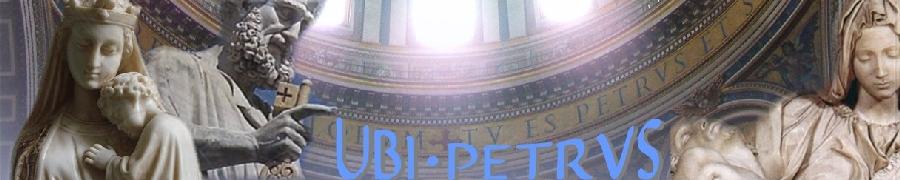
Why “Ubi Petrus?”

Ubi Petrus ibi ecclesia, et ibi ecclesia vita eterna.
Where there is Peter there is the Church,where there is the Church there is life eternal!
— St. Ambrose of Milan

Patron Saints

Saint Ambrose
Saint Ambrose, ora pro nobis!

Saint Peter with keys
Saint Peter, ora pro nobis

Our Lady Seat of Wisdom
Our Lady Seat of Wisdom, ora pro nobis

Archives

Follow me on twitter

Catholic Blogs Page

Categories